
The Best Yin Yoga Teacher Trainings In Australia
A 2026 guide to current Australian Yin teacher trainings, what the style actually is, and how to pick a course that will still be useful in the room.
Yin Yoga teacher training in Australia is a short add-on, not a second 200-hour diploma. The useful courses teach you how to hold a slow class: long passive poses, props, fascia, and enough theory that you can explain why students are staying in a shape for several minutes. If you are still deciding whether Yin is the style you want to teach, start with which yoga is best for you.
This page was checked in September 2026. Dates, trainers and websites change. Confirm the next intake on the school site before you pay a deposit. The older version of this article listed a 1000-hour Australian Yin diploma, misspelled Kai Yoga as Kia, named trainers who no longer lead those courses, and included a Singapore school as if it were Australian.
Table of Contents
What Yin Yoga actually is
Yin is a slow style. You settle into a pose, usually seated or reclined, relax the muscles, and stay for two to five minutes, sometimes longer. The aim is connective tissue and joints rather than a sweaty yang class. Most rooms are not heated, which is why studios can run Yin almost anywhere.
Typical shapes include butterfly, caterpillar (a seated forward fold), frog and dragon. Breath is quiet. Some teachers use a longer exhale. The old cue to pull the navel to the spine belongs more to a yang or core class than to Yin. If you want a simple map of breath work, see which pranayama is best for you.
A Yin room lives on props: bolsters, blankets and blocks. Our notes on yoga bolsters cover the ones students actually use. Yin studios and Yin classes are easy to find in Australia, as well as in the United States, Asia and Europe. If you want a class rather than a training, start with our list of Yin and Yang studios in Australia.
Where the modern style comes from
Paulie Zink, a martial artist and Taoist yoga teacher, developed a yin-yang / Taoist yoga in the late 1970s. That is one person, not a group of martial arts experts, and his original art includes more movement and animal forms than the quiet class most Australian studios now call Yin.
Paul Grilley studied with Zink, then combined those long-held poses with functional anatomy and the meridian work of Hiroshi Motoyama. Sarah Powers, a student of Grilley, suggested the name Yin Yoga and helped spread the style that most trainings below actually teach. Bernie Clark later wrote the teaching texts many courses still put on the reading list. All three sit in our guide to famous yoga teachers and their contribution in the West.
The line that Taoist priests taught these exact poses to kung fu students 2,000 years ago is folklore. Long-held stretches and qigong have older roots. The named studio practice called Yin Yoga is modern.
Yin and yang in the yoga room
In Chinese thought, yin and yang are complementary qualities, not a moral pairing of bad and good. Yin is the quieter, cooler, more inward side. Yang is more active, warmer and outward. They shift. Each contains a bit of the other.
The old textbook line that yin is “negative, dark and feminine” and yang is “positive, bright and masculine” is a flattened version of that idea. In a yoga room the useful split is simpler: Yin is the long-held, passive work. Vinyasa, Ashtanga and similar classes are the yang side. Many teachers offer both. Restorative, Yin and Yoga Nidra are also the classes students now ask for in the latest yoga trends.
What Yin can and cannot do
Students often come to Yin for:
- a slower class that targets fascia and connective tissue rather than muscle strength
- joint mobility work, with props, if the teacher understands skeletal variation
- a quieter hour that can help with stress, provided the room and the teaching feel safe. Some students use a slow evening class when they want help sleeping
- practice staying with sensation, which some people use as a bridge into meditation or Yoga Nidra / iRest
- a complement to stronger yang classes, not a replacement for them
It is not a treatment for arthritis, osteoporosis or injuries. A gentle class can be useful for some people with those conditions. Long holds and deep stretches can also be the wrong choice. That is a conversation with a health professional and a teacher who can modify, not a reason to book a training. For the room itself, see tips for safe and healthy yoga studios.
Do you need a Yin certificate?
There is no single certifying body for Yin Yoga in Australia. Completing a course gives you that school’s certificate. It does not by itself make you a yoga teacher, and it is not a government licence.
Australian courses are usually 25, 30, 50, 75 or 100 hours. A 1000-hour Yin diploma exists, but it is an international modular program, not a typical Australian studio course. For how a first 200-hour training fits, see our 200-hour teacher training notes and how to become a yoga teacher in Australia. Other specialty paths on this site include Dru Yoga teacher training and 200- and 500-hour trainings in India.
Three names get mixed up on sales pages:
- Yoga Australia is the local peak body. Many teachers collect continuing professional development hours here.
- Yoga Alliance is the United States registry used worldwide.
- Yoga Alliance International is a separate registry. Australian Yoga Academy, for example, uses this one for its Yin course.
Dedicated students can usually attend. Teaching credits typically go only to people who already hold a 200-hour qualification. If you plan to teach, you will also want insurance and first aid. Start with professional indemnity insurance for yoga. Pay and the first business steps sit in how much yoga teachers make and tips to start a yoga business.
How to choose a training
- Who teaches it, and whether they come from the Grilley / Powers / Clark stream, Chinese medicine, fascia work, or a mix.
- Hours and format: one weekend, two weekends, a week, or a hybrid with online modules.
- Whether you get teaching practice, not only lectures and a manual. You will still need to build a sequence for class once you are back in the room.
- Which registry, if any, will recognise the hours.
- Current dates. Several school pages still show intakes that have already finished.
Current trainings in Australia
These are solid, currently operating options. They are not a ranked league table. Prices below were published on the school sites in September 2026 and will move.
1. Sukha Mukha Yoga, Bondi
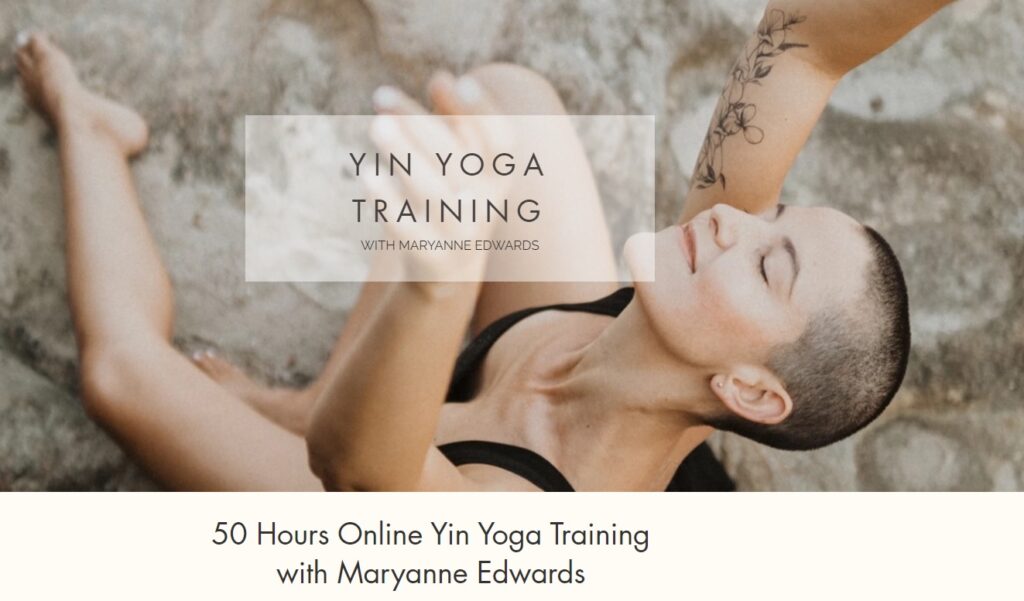
Sukha Mukha’s Yin course is a 50-hour in-studio training with Maryanne Edwards in North Bondi, plus pre-recorded tutorials. It covers yin-yang theory, traditional Chinese medicine as it relates to organs and elements, mindfulness, and the role of a slow practice.
Maryanne first studied at Sukha Mukha with Idit Hefer Tamir and Jasmine Tarkeshi. For Yin she has studied with Sarah Powers and through Embodied Flow. The school says the course is open to everyone; only already-certified teachers receive the 50 hours toward Yoga Alliance 350- or 500-hour pathways.
The public page still showed a February–March 2024 intake when we checked. Treat that as proof the course exists, not as a date you can book. Ask Sukha Mukha for the next round.
2. Australian Yoga Academy, Melbourne
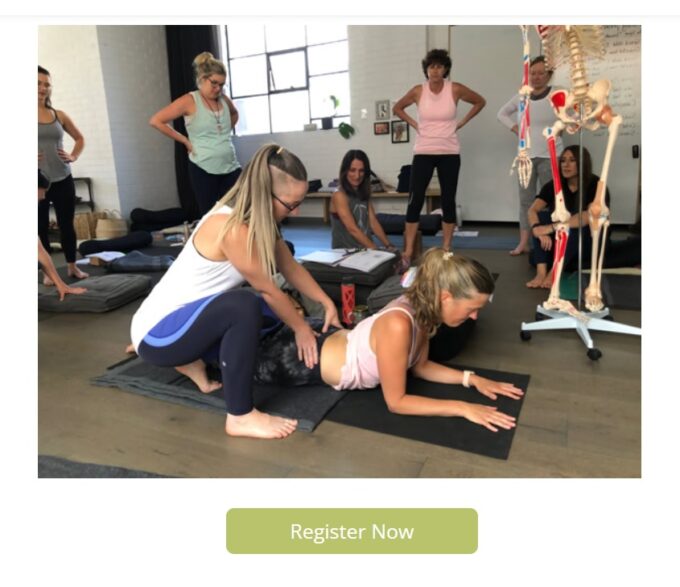
AYA still offers a 50-hour Yin Yoga teacher training at 42 Clifton Street, Prahran. The lead trainer is now Melanie Mackintosh, not Karina Smith. Karina taught Yin and anatomy at AYA for several years and now runs her own training, listed below.
The 2026 dates are lectures on 5, 11 and 12 July and 22 and 23 August, plus Zoom sessions on 8 and 15 July. You can attend in the room, on Zoom, or mix both. Published fees were $1,250 early bird until 25 June 2026, $1,450 after that, and $1,095 for AYA graduates and current trainees.
AYA accredits this course with Yoga Alliance International Registry, not Yoga Alliance USA. Completing it does not replace a minimum 200-hour diploma if you want to teach adults. Course page and enrolment.
3. Kai Yoga, Corrimal
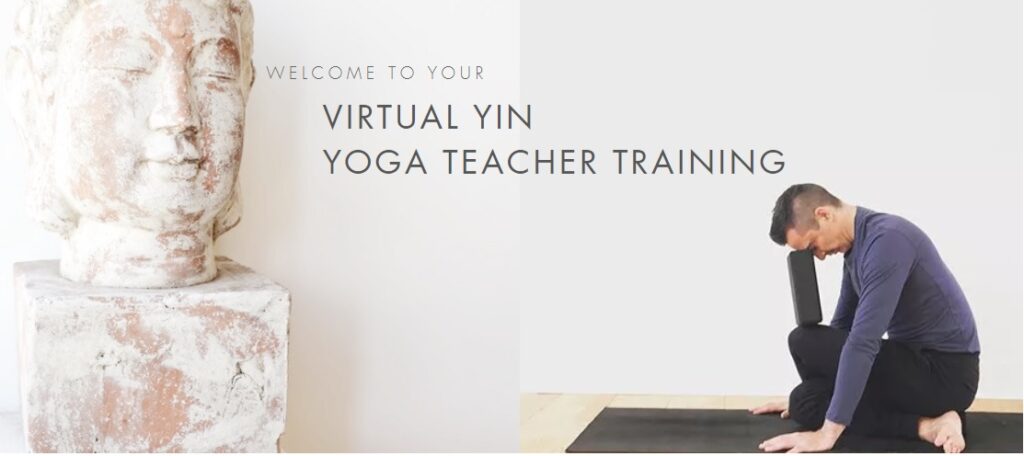
This is Kai Yoga, not Kia Yoga. Fraser Guthrie and Elisha Young run the Corrimal studio with acupuncturist and yoga teacher Emma Burridge. The Yin training is 50 hours, not 40, over two long weekends, or the same content on demand.
The syllabus includes five-element theory, meridians, yin tissue anatomy, pranayama, meditation, props and myofascial release. It is open to 200-hour teachers and to dedicated students. Completing it counts as Yoga Alliance continuing education and can sit on a 500-hour pathway. Published in-person fees were $1,190 early bird and $1,490 full price.
The last published in-person block was 28–30 November and 5–7 December 2025. On-demand study remains available. If you later teach that material on Zoom, our tips for teaching online yoga classes cover the practical side. Check Kai Yoga’s Yin training page for the next studio dates.
4. Sarah Owen, Canberra and online
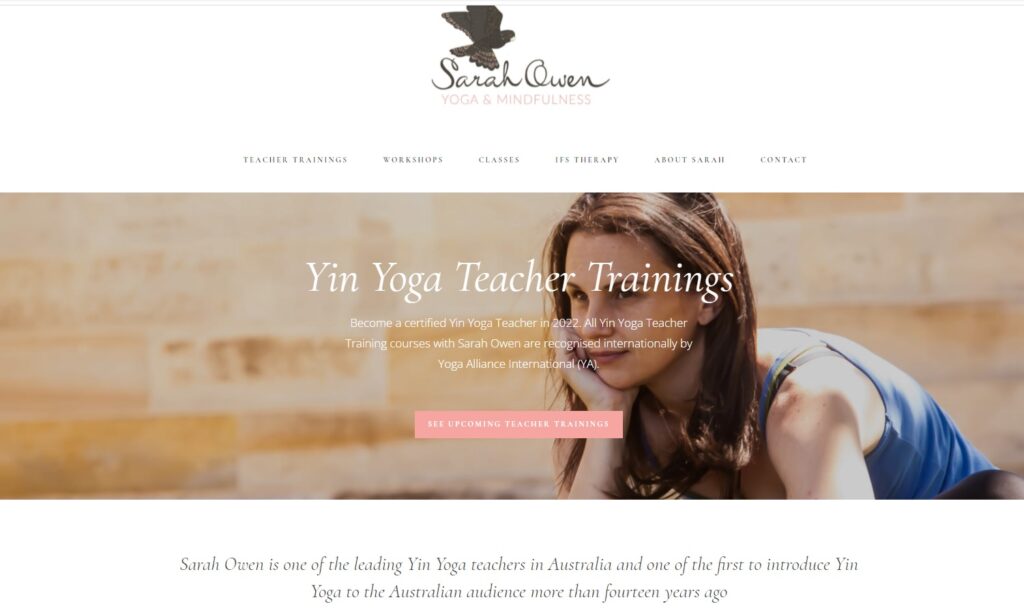
Sarah Owen has taught yoga since 2006 and was among the first teachers to bring Yin to a wider Australian audience. She is an Insight Yoga teacher endorsed by Sarah Powers’ Insight Yoga Institute, and she has coordinated Sarah Powers’ Australian programs. Studio biographies still describe her as the only Australian teacher with that endorsement.
Her Yin and mindfulness teacher training is three modules, about 125 hours in total, historically offered in Canberra, Sydney, Melbourne, Byron Bay and online. Modules can be taken without a fixed order. Older copy on this page said “more than fourteen years ago” and linked to sarahowenyoga.com. That site no longer resolves.
Current public pages sit with The Making Space and her Linktree. Ask there for the next module dates rather than treating an old workshop flyer as current.
5. Warrior One Yoga, Mordialloc
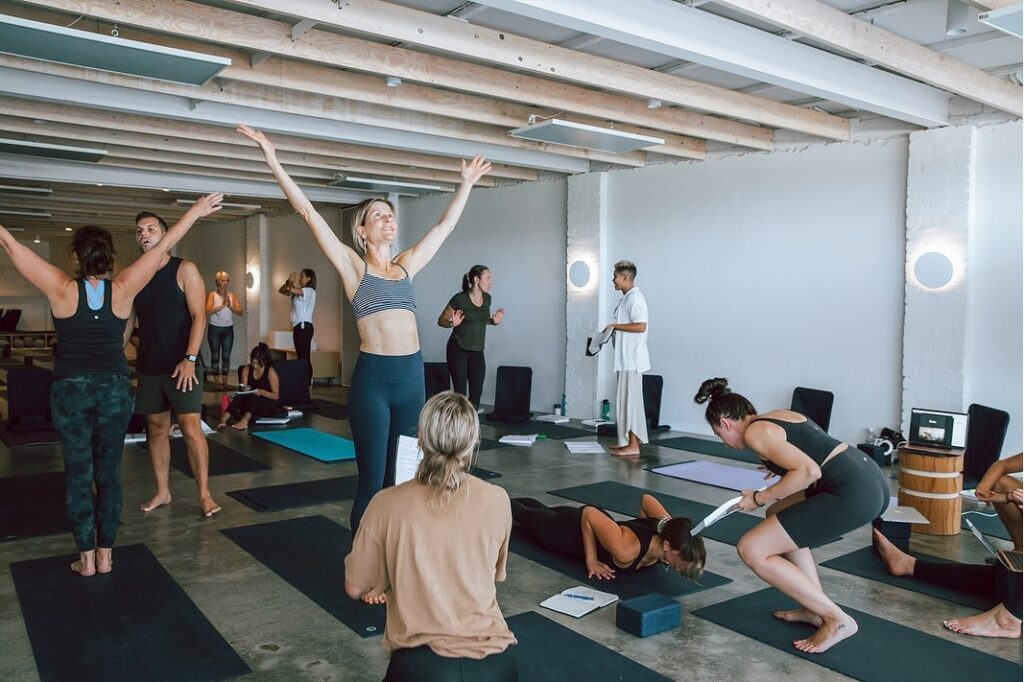
Warrior One still runs a 25-hour Yin Yoga and myofascial release training. The current lead pair is Rayne Watkin and Sarah Hammond, not Monica and Megan. Rayne brings osteopathy and bodywork. Sarah leads the Yoga Tune Up myofascial release work.
The next published dates are 16–18 October 2026 at 228 Beach Road, Mordialloc, 9am to 6pm, $950. The course covers Yin theory, fascia, meridians, sequencing and teaching skills. Students and teachers can attend. The school says a 200-hour qualification, insurance and first aid are the usual baseline if you want to teach afterwards.
Warrior One Yin training details.
6. Dr Karina Smith, Newport, Melbourne
Karina Smith is an AHPRA-registered acupuncturist and a Yin teacher trainer. She lectured in anatomy and Yin at Australian Yoga Academy for more than seven years and now runs her own 50-hour Level 1 in Melbourne’s west. The course is aimed at teachers who want to add Yin and at students who want more depth. It is accredited with Yoga Alliance.
The 2026 Level 1 is her last in-person Level 1 for a while. It includes an online meet-and-greet on 16 October, five studio days from 21 to 25 October at Think Focus Act, 33 Challis Street, Newport, plus 20 hours of online modules with lifetime access. Published fee: $1,675. The emphasis is skeletal variation, functional anatomy, props and basic meridian theory.
7. Power Living, online or hybrid in Manly
Power Living runs a longer Yin module as part of its 500-hour pathway: 75 hours fully online, or 100 hours hybrid with in-person days in Manly. Duncan Peak founded the school. The Yin faculty also includes Keenan Crisp and Emma Burridge. The course is certified by both Yoga Australia and Yoga Alliance.
Content covers functional anatomy, fascia, meridians, sequencing and how to hold a slow class. 200-hour graduates from other schools can join the advanced modules. People without a 200-hour certificate can often attend, but only certified teachers receive the accreditation hours.
Intake dates move. When we checked, the site listed a September start with online or hybrid options. Use the Power Living Yin page for the next cohort.
8. Lara Zilibowitz, Byron Bay and online
Lara Zilibowitz is a Byron Bay teacher, transpersonal therapist and the founder of Body Poetry Yoga. She has studied Insight Yin with Sarah Powers and teaches a Tantric, somatic version of Yin rather than the standard Grilley / Chinese-medicine syllabus.
Her current teacher training is a 50-hour live online course, Tantric Yin and Meditation, over six Sundays from 23 August to 27 September 2026, 10am to 5pm AEST. Students in Australia and Asia can attend every live call. Replays stay on a student portal for six months. The page is clear that there is no TCM theory. Content covers yin anatomy, fascia, sequencing, nervous-system work, polyvagal theory and trauma-informed holding.
Dedicated students can join if they already have some seated meditation and a baseline Yin practice. You do not need a 200-hour certificate to attend. Published fee: AU$1,450 plus GST. The course is listed as Yoga Alliance International / Yoga Alliance continuing education. She also runs in-person classes and workshops around Byron, including BodyMindLife, but the 2026 training itself is online. Lara’s Tantric Yin training page.
9. Mel McLaughlin, The Yin Space
Mel McLaughlin runs The Yin Space and is one of the Australian trainers who studied directly with Paul Grilley. She has more than 240 hours through his US programs and offers her own Yoga Australia recognised 50-hour, 100-hour and advanced Yin courses. The 50-hour hybrid is four studio days plus one day of pre-recorded study.
Published 2026 urban immersions include Adelaide at Buddha House, Magill, 3–6 September, and Sydney at The Dale Loft, Chippendale, 11–14 June and 22–25 October. The syllabus covers meridians, organ pairs, TCM and Taoist theory, functional poses, chakras, wall Yin and long practice sessions. She also offers a separate 20-hour myofascial release and acupressure add-on in the same cities.
Teachers who want a teaching certificate need a 200-hour foundation. Dedicated students can attend for their own practice. Hours are recognised by Yoga Alliance / YACEP and Yoga Australia for CPD. Published fee for the 50-hour hybrid was $1,200. Check Mel’s tour dates before you book, because cities move.
Other Australian courses to check
These were also running when we checked, and they fill gaps the list above does not cover.
Nambour Yoga Centre, Sunshine Coast, offers a 100-hour blended training with Michelle Freeman and Christine McDaniel: more than 30 hours online plus two in-person weekends. Hours count as Yoga Australia continuing education for people who already hold 200 hours or more. Published 2026 dates have included May and October intakes, so confirm on the site. The listed fee was about $2,499.
Grass Roots Yoga in St Kilda runs a 30-hour Yoga Australia accredited course with Janita Doelken and Alessia Frisina. The next published block is 6–7 and 13–14 March 2027, $1,150. It is in person, with a TCM guest teacher, and needs 100 percent attendance for the certificate.
International and online options
The previous version of this article listed two courses as if they were current Australian studio trainings. They are still useful to know about. They are not Australian schools.
Yinspiration, founded by Jo Phee in Singapore in 2012, offers modular Yin, Chinese medicine, AcuYin and MyoYin trainings, including a 1000-hour Diploma in Yin Yoga. Jo Phee teaches online and in places such as Bali, London and the United States. That is an international pathway, not a Bondi or Melbourne diploma. If a Bali module turns into a retreat you are hosting, read how to legally hold yoga retreats in Bali.
Living Yin is Truth Robinson’s school. He is a doctor of traditional Chinese medicine and used to run 30- and 50-hour immersions at Yoga Body Works in Newcastle. Those studio dates are from 2019 and 2022. He now offers a 50- or 70-hour Yoga Alliance YACEP training through Living Yin. Yoga Body Works in Newcastle is still open and runs other trainings, including Yin and Yang work with other teachers. It is no longer the place to book Truth’s Yin course.
Frequently asked questions
Do I need a Yin Yoga certificate to teach Yin in Australia?
No single body licences Yin teaching in Australia. A course certificate shows you completed that course. Studios and insurers usually want a 200-hour foundation, first aid, insurance and relevant continuing education. A short Yin training is an add-on, not a substitute for a foundational teacher training.
How long is a typical Yin Yoga teacher training in Australia?
Most current Australian courses are 25 to 100 hours. Weekend intensives sit at the short end. Blended or hybrid courses, such as Power Living or Nambour Yoga Centre, run longer. A 1000-hour Yin diploma exists internationally. It is not a standard Australian offering.
What is the difference between Yoga Australia and Yoga Alliance?
Yoga Australia is the local peak body. Many Australian teachers use its continuing professional development hours. Yoga Alliance is a United States registry used worldwide. Yoga Alliance International is a third, separate registry. A school can be recognised by one, two or none of them. Check which one you actually need for insurance or membership.
Can I do Yin teacher training if I am not already a yoga teacher?
Usually yes, as a dedicated student. Most schools will let you attend and give a certificate of completion. Teaching credits and Yoga Australia or Yoga Alliance hours typically go only to people who already hold a 200-hour qualification.
Is Yin Yoga safe for arthritis or osteoporosis?
Not automatically. A slow class can be useful for some people, but long holds and deep stretches can be the wrong choice for some bone and joint conditions. That is a medical question, not a marketing claim. Get advice from a health professional and a teacher who can modify.
The bottom line
Pick the course that matches the hours you need, the city you can reach, and the teacher whose lineage you actually want. A 25-hour weekend will not do the same job as a 100-hour blended course. A Singapore diploma will not help you if you needed Yoga Australia hours this year.
Check the date on the sales page. If the last intake is in the past, email the school. Then decide whether you are training to teach, or training to practise more carefully. Both are valid. Only one of them belongs on a studio timetable.
If you already teach and you are adding Yin to the weekly schedule, the operations side is the same as any other class: a clear description, the right room, and a booking page students can use. A slower class can also help with client retention if the rest of the timetable is strong. Our notes on studio schedules, filling classes, class attendance and booking systems for new teachers cover that part. Studio owners hiring a Yin teacher can start with six ways to find the best yoga teacher.