
Are Yoga Studios Dying in Australia? Why Studios Struggle While Pilates Booms
People have not stopped moving. They have stopped paying for studios that feel interchangeable.
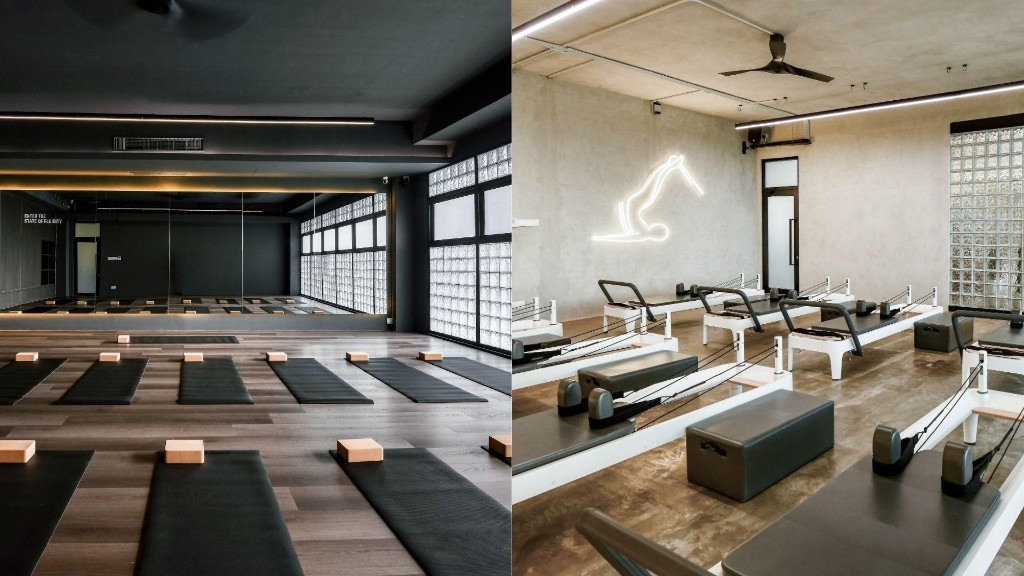
Yoga is not dying in Australia. Interchangeable yoga studios are. Every few months a studio closure, a sudden timetable cut or a heated thread among teachers sparks the same question: have Australians turned their backs on yoga?
When you separate the practice from the bricks-and-mortar business model, a much clearer picture emerges. Australians have not stopped rolling out a mat, and they certainly have not stopped spending money on movement. What they have stopped doing is paying boutique prices for a room that feels like an average gym workout, a revolving door of newly minted teachers, or a business that preaches community on Instagram while struggling to pay its instructors on time.
Table of Contents
The short answer and the three numbers that matter
If you own or teach at a studio in Sydney, Melbourne, Brisbane, Perth or a regional coastal town, you do not need a motivational pep talk. You need the numbers.
Yoga Australia's State of Yoga 2026 report pulls together IBISWorld industry data, ABS living-cost indexes and AusPlay national participation figures. Alongside IBISWorld's 2025-26 Pilates and Yoga Studios analysis, three facts explain why so many studio owners feel like they are running uphill:
- Participation in yoga is steady, not collapsing: AusPlay's 2025 figures show about 1.15 million Australians practised yoga, up 4%. Pilates jumped 26% to 1.63 million over the same period.
- Total studio revenue is roughly a third smaller than its pre-COVID peak: IBISWorld figures cited by Yoga Australia put combined Australian Pilates and yoga studio turnover at about $630 million in 2025 (and $670.7 million in IBISWorld's April 2026 update), down from roughly $1.04 billion at the 2019 peak.
- Studio count kept climbing anyway: Instead of consolidating, the number of studios rose to between 3,700 and 3,823 businesses. More rooms are splitting a smaller pool of discretionary spending.
That is the core tension in Australian yoga right now. Demand for yoga is real, as our breakdown of the latest yoga trends in Australia shows, and specific niches still fill every week. The squeeze is happening because nearly four thousand studios are competing for households whose living costs rose 34.4% between June 2015 and June 2025 while wages rose 28.9%.
Why Pilates and strength are winning the casual booking
Ask a former yoga member where their fortnightly membership went and the answer is almost always Reformer Pilates, mat Pilates or a strength-focused gym.
Australian Google Trends data from 2004 to the present makes the timeline unmistakable. Search interest in yoga (the blue line below) climbed steadily from 2011 and hit its golden peak between 2015 and 2020, regularly scoring between 75 and 100 on Google's index while Pilates sat down around 15 to 25. After 2020, yoga search interest cooled back toward its long-term Australian average of 55 instead of crashing to zero. Meanwhile, Pilates (the red line) surged from 2022 onwards, and across the last two years the two curves have run almost dead-even around 45 to 58.
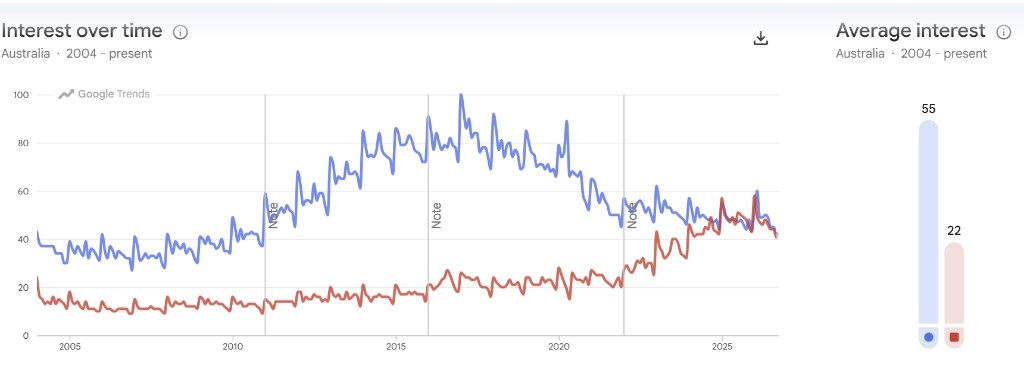
That search convergence explains why yoga studio owners feel the shift so acutely: yoga did not vanish, but its decade-long search monopoly between 2015 and 2020 is over, and every new casual searcher is now split roughly 50/50 with Pilates.
In the AUSactive 2026 Australian Fitness Trends Report, Fitness Programs for Older Adults held the number 1 spot, Pilates climbed to number 2, traditional strength training moved back up the rankings, and yoga sat at number 13. Being number 13 in the country is hardly extinction, but yoga is no longer the default boutique membership for a 28-year-old with $65 a week to spend.
Why did that shift happen so fast?
- A tangible physical promise: Pilates markets a specific outcome: core strength, posture, joint-friendly resistance and visible progression on a machine. A student knows what they are buying in week one and how to measure it by week eight.
- Lower emotional friction: Many beginners come to movement through the exercise door. A Reformer or mat Pilates class tells you which springs to clip on and how many repetitions to complete. A quiet room that asks you to sit with discomfort, stillness or unfamiliar philosophy can feel confrontational when someone just wants to move after eight hours on a laptop.
- The current social aesthetic: Right now, Reformer Pilates carries the polished, low-impact "clean aesthetic" across social feeds that hot vinyasa carried ten years ago. Trends cycle, and Reformer studios signing expensive leases today will face the exact same test once the novelty cools.
Our guide to Pilates vs yoga and our notes on teaching Pilates at a yoga studio look at how operators bridge that gap without losing their identity.
Too many 200-hour teacher trainings and not enough students
Talk to veteran teachers across Australia and one frustration comes up immediately: for a decade, studios used 200-hour Yoga Teacher Trainings (YTTs) to plug holes in their cashflow.
When weekly class margins tightened, running two or three teacher trainings a year at $3,500 to $5,000 per student looked like the easiest way to pay commercial rent. Online and hybrid fast-track certificates made the funnel even wider. Even offshore intensives felt the squeeze recently, with tighter Indonesian visa and work-permit enforcement reminding Australian teachers who legally hold yoga retreats in Bali (and use our Bali retreat legal checklist) that offshore programs are not a friction-free sideline either.
Inside local studios, the math of non-stop teacher training eventually turned on itself:
- You cannibalise your best members: The students most likely to pay $4,000 for a teacher training are your most dedicated unlimited-membership holders. Once they graduate, they want to teach, or they expect staff privileges, or they open a competing hall class ten minutes down the road.
- Class quality becomes inconsistent: When a timetable is staffed by rotating graduates with 200 hours of weekend study and very little mentoring, regular students notice. Cueing becomes generic, adjustments disappear, and nobody can explain how to modify a pose for a cranky shoulder.
- Senior teachers get priced out: When a suburb has forty newly certified teachers willing to teach for free memberships or $45 a class just to get experience, teachers with ten years of study struggle to command a liveable rate.
Students rarely quit yoga because they hate savasana. They drift away when three classes in a row feel like a memorised script delivered by someone who only finished training last month. If you are weighing up training pathways yourself, read our guide to becoming a yoga teacher in Australia and our 200-hour YTT recommendations.
What happened when yoga was sold only as a workout
There is an irony at the heart of the modern studio slump. To make yoga palatable to the mainstream fitness market in the 2010s, many studios stripped away the philosophy, breathwork, nervous-system regulation and lineage, repackaging asana as a sweaty calisthenics class with nice lighting.
That worked until the fitness market built better mousetraps for pure aesthetics and conditioning.
If a student's only goal is learning a handstand, a calisthenics coach will get them there faster. If their only goal is front splits, a mobility or contortion coach is more direct. If their goal is glute and core tone in 45 minutes, a Reformer class has springs designed for the job. By reducing yoga to a calorie burn, workout-only yoga studios put themselves in direct competition with modalities engineered specifically for physical output.
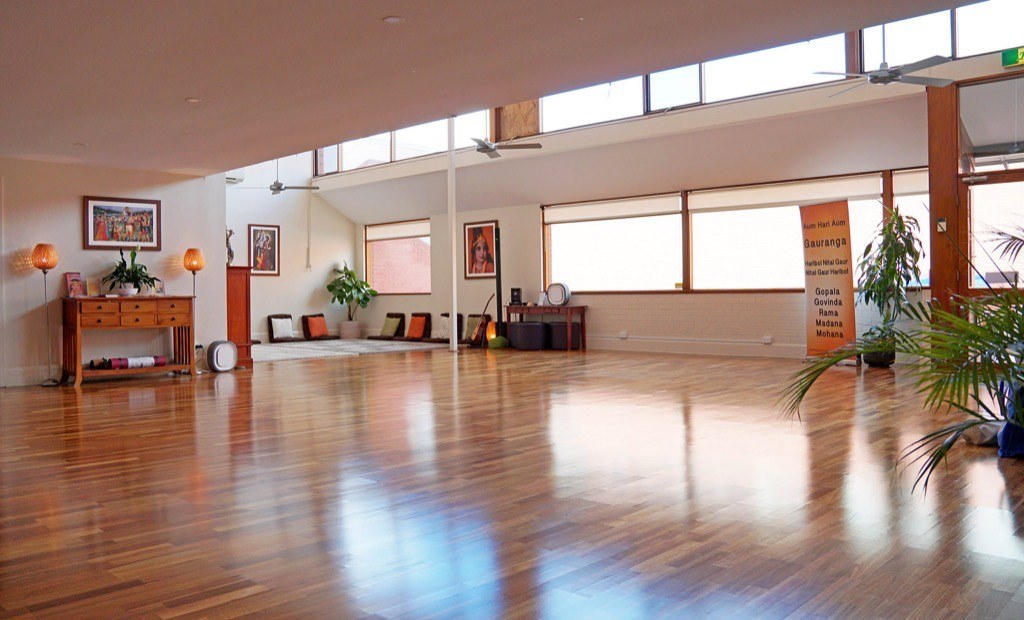
At the same time, the opposite extreme also pushes Australians away. Nobody wants to pay $32 to be lectured by a teacher performing spiritual superiority without substance, or to walk into a room heavy with cliques and vague "love and light" platitudes that ignore how hard real life feels.
Real yoga sits between those two failure modes. It is a physical, mental and nervous-system practice with genuine depth, taught by someone humble enough to meet a beginner where they are. When a studio loses both physical progression and genuine contemplative depth, classes become interchangeable. And interchangeable classes lose to the cheapest or flashiest option on the street.
The studio P&L squeeze: rent spikes, the $75,000 GST cliff and teacher pay
Some of the loudest arguments online blame yoga studio closures on greed or bad vibes. Sometimes poor management is to blame. Just as often, the numbers on an Australian commercial lease simply stop working.
Commercial rent, outgoings and fixed overheads
Running a dedicated bricks-and-mortar room means paying commercial rent, council rates or outgoings, public liability and professional indemnity insurance, electricity for heating or cooling, cleaning, music licensing (OneMusic Australia) and software before a single student checks in.
In late 2025, Western Sydney operator Nin Yoga publicly shared why it closed its original St Marys studio and consolidated classes into Penrith at the start of 2026: the landlord notified them of a 72% rent increase. Even well-loved community studios cannot absorb a 72% jump in fixed occupancy cost simply by squeezing two more mats into the 6pm vinyasa.
The $75,000 GST threshold
Solo teachers renting a community hall for a few classes a week often sit under the Australian Taxation Office's $75,000 annual GST turnover threshold. The moment an independent studio grows into a permanent space with multiple teachers, turnover crosses $75,000 and GST registration becomes mandatory.
Unlike certain allied-health services, commercial yoga and Pilates classes are taxable supplies. Crossing that line means one-eleventh of every class pack and membership goes to the ATO. Because local competition and household budgets cap what students will pay for a casual drop-in or weekly direct debit, many small studio owners feel like they work twice as hard above $75,000 just to take home what they earned when they were small. You can model that exact margin impact with our yoga studio revenue calculator and yoga teacher tax deductions guide.
Teacher pay and the hypocrisy gap
Nothing destroys a yoga studio's reputation faster than marketing "sangha, compassion and integrity" to members while paying teachers late, undercutting rates or ignoring superannuation obligations behind the scenes.
According to Yoga Australia's 2026 report:
- The Fitness Industry Award sets the legal minimum for a casual Level 2 instructor at $33.05 an hour from July 2026.
- Self-employed teachers across Australia typically charge studios and gyms between $50 and $100 per class.
- Roughly 60% of Australian yoga teachers work as contractors, and under ATO rules, contractors paid mainly for their personal labour are generally entitled to superannuation guarantee contributions even when they invoice with an ABN.
Paying teachers properly and on the day payday falls is baseline respect. If a timetable only survives on paper when instructors are paid late or expected to clean the bathrooms for free, the timetable has too many unprofitable slots. Read more on what yoga and Pilates teachers in Australia actually experience and the wider challenges in the business side of yoga.
Big-box gyms and home practice are the real leak
Look closely at the AusPlay participation breakdown in Yoga Australia's 2026 report and you will see where the missing studio bookings went.
Of the 1.63 million Australians who do Pilates, 1,258,620 (77%) do it in an organised setting through a studio, gym or club. That makes sense: most people do not keep a $6,000 reformer in their spare bedroom.
Of the 1.15 million Australians who practise yoga, only 657,978 (57%) do so through an organised studio, gym or club. Nearly half of Australian yoga practitioners practise unorganised at home, outdoors or online.
That creates a two-sided squeeze for standalone yoga studios:
- Health clubs bundle yoga for free: Full-service gyms and lifestyle clubs offer weights, cardio, saunas, recovery zones and ten weekly yoga or mat Pilates classes for $25 to $55 a week. If a boutique studio's class feels identical to the gym class down the road, cost-conscious members consolidate into the gym.
- Home practice handles the basics: Free yoga YouTube channels and low-cost yoga apps are good enough for a 20-minute morning stretch between work calls.
A dedicated yoga studio only wins when it offers what a gym floor and a living room cannot: skilled observation, nervous-system quiet, a cohort that knows your name, and a clear path of study.
What still fills an Australian yoga studio in 2026
Plenty of pure yoga studios in Australia are still growing after ten years in business. They are rarely the ones chasing every TikTok aesthetic or discounting memberships to $19 a week. Here is what they do differently:
1. Trim the timetable until every class pays its way
An 18-class timetable with 14 people in each room is profitable, energising and allows you to pay teachers on time. A 42-class timetable with four people in each room bleeds rent and burns out your staff. Use our guide on how to make a yoga studio schedule and how to launch a yoga studio in Australia to calculate exact break-even attendance per slot.
2. Teach progression and nervous-system depth
Give students a reason to stay past their intro offer. Run 6-week beginner courses, mobility and strength progressions for lifters and runners, and dedicated Restorative, Yin, Yin teacher pathways or Yoga Nidra sessions where students actually down-regulate. Even small touches, like adding a brief weekly philosophy or pranayama thread, separate a true studio from a gym class.
3. Prepare for private health rebates and clinical referrals
As Yoga Australia notes in its 2026 update, private health insurance recognition is returning for appropriately registered teachers, lifting senior teachers closer to allied-health recognition as health funds roll out updated product suites. Studios that work with experienced, registered teachers and issue proper tax invoices and claim receipts are positioned for referrals that a generic fitness franchise cannot touch.
4. Cut admin overhead before cutting teacher pay
You cannot negotiate your electricity tariff down by 50%, and you should never balance the books by paying teachers late. You can control what you spend on front-desk receptionists and bloated US software subscriptions.
Switching from high-fee foreign platforms to local yoga studio management software in Australia keeps software costs in predictable Australian dollars (CoreBookings plans sit at A$59 to A$149 per month plus GST) while automating rolls, waitlists, intro-offer follow-ups and passes. See our practical playbooks on how to fill your yoga classes and how to grow a yoga studio.
Sources
- Yoga Australia, State of Yoga 2026: cites IBISWorld 2025 studio revenue (~$630 million, down from ~$1.04 billion in 2019) across ~3,700 studios; ABS Selected Living Cost Indexes (+34.4%) vs Wage Price Index (+28.9%) from June 2015 to June 2025; AusPlay 2025 participation for Pilates (1.63 million, +26%, 77% organised) and yoga (1.15 million, +4%, 57% organised); Fitness Industry Award casual Level 2 rate ($33.05/hr from July 2026); contractor share (~60%) and typical class rates ($50 to $100); private health rebate rollout.
- IBISWorld, Pilates and Yoga Studios in Australia Industry Analysis (April 2026): estimates 2025-26 industry revenue at $670.7 million (-3.9% annualised over five years) across 3,823 businesses (+3.4% CAGR between 2021 and 2026).
- AUSactive / AusLeisure 2026 Australian Fitness Trends Report: ranks Fitness Programs for Older Adults at #1, Pilates at #2, and Yoga at #13 in Australia for 2026.
- Google Trends Australia (2004 to present, Yoga vs Pilates): shows Australian yoga search interest peaking between 2015 and 2020 (long-term average index 55 vs 22 for Pilates) before converging to sit nearly level with Pilates across 2024 to 2026.
- Nin Yoga, St Marys Studio Closure Update: public studio-owner account documenting consolidation into Penrith at the start of 2026 following a notified 72% commercial rent increase.
Frequently asked questions
Are yoga studios dying in Australia?
Yoga itself is not dying. AusPlay 2025 data cited by Yoga Australia puts adult yoga participation at roughly 1.15 million, up 4%. What is under pressure is the standalone studio business model: around 3,700 to 3,823 Pilates and yoga studios are splitting roughly $630 million to $670.7 million in annual revenue, down from about $1.04 billion at the 2019 peak.
Why is Pilates growing faster than yoga in Australia?
Pilates sells a very clear physical promise around core strength, posture, low-impact resistance and visible progression, and 77% of Australian Pilates participants practise in an organised studio, gym or club compared with 57% for yoga. Google Trends Australia data shows yoga peaked between 2015 and 2020 before settling near its long-term average of 55, while Pilates surged from 2022 to sit almost level with yoga in Australian search interest over the last two years.
Have 200-hour yoga teacher trainings oversaturated the Australian market?
Yes. Many studios came to rely on running two or three fast-track teacher trainings a year to pay rent. That converted their most loyal full-fee members into newly qualified instructors competing for the same teaching slots, while leaving fewer experienced teachers able to earn a sustainable living.
What are yoga teachers paid in Australia in 2026?
According to Yoga Australia's State of Yoga 2026 report, around 60% of Australian yoga teachers work as independent contractors and typically charge studios or gyms $50 to $100 per class. For employees, the Fitness Industry Award sets a casual Level 2 instructor legal floor of $33.05 per hour from July 2026, plus superannuation.
How does the $75,000 GST threshold hurt growing yoga studios?
Once an Australian studio's annual turnover reaches or is expected to reach $75,000, it must register for GST. Because commercial yoga classes are taxable and local competition caps how far class prices can rise, crossing that threshold means remitting one-eleventh of gross class revenue to the ATO unless attendance or pricing rises enough to cover the gap.
The bottom line
Australians have not fallen out of love with yoga. More than a million adults still practise every year. What ended is the era where any leased room with timber floors, a neon sign and a 200-hour teacher training could fill classes on autopilot.
The studios thriving in 2026 know exactly what they stand for. They run a tight, profitable timetable, pay skilled teachers on time, price for the $75,000 GST reality, and give students a practice with enough depth and progression that neither a big-box gym nor a free YouTube video can replace it.